
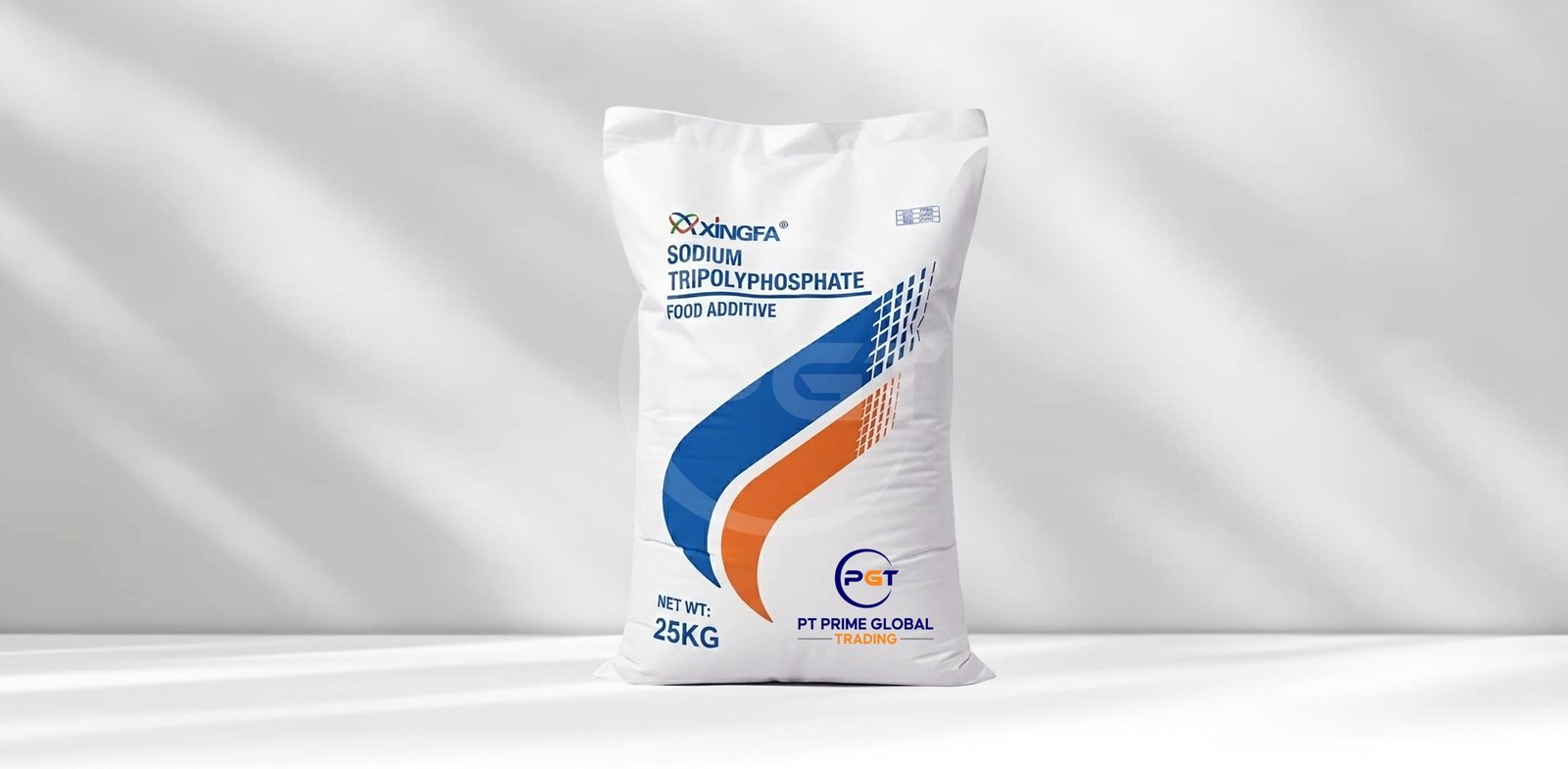
The Dual Power of STPP: Balancing Food Preservation and Industrial Efficiency
In the global chemical supply chain, few compounds pull double duty quite as effectively as Sodium Tripolyphosphate, commonly known as STPP.
To a food scientist, it is an invaluable tool for maintaining moisture, texture, and tenderness in proteins. To an industrial formulation chemist, it is a heavy-duty water softener and cleaning booster. This dual nature makes STPP an incredibly high-demand commodity across international trade networks, particularly in rapidly growing manufacturing hubs like Indonesia.
If you are a procurement professional or chemical formulator, understanding the distinct operational behaviors of STPP grades is critical to choosing the exact raw material for your factory lines.
What is Sodium Tripolyphosphate (STPP)?
STPP is an inorganic salt compound ($\text{Na}_5\text{P}_3\text{O}_{10}$) that appears as a white, water-soluble, granular powder. It is produced by carefully heating a precise stoichiometric mixture of disodium phosphate and monosodium phosphate under strict temperature controls.
Its chemical structure gives it two highly prized functional capabilities: moisture binding and metal ion chelating (binding to loose minerals in water). Because its applications are so wildly different, production lines are rigidly split into two distinct, non-overlapping categories.
1. Food Grade STPP: Protecting Quality and Yield
In commercial food processing, managing water content is a matter of both product quality and economic survival. Proteins naturally lose moisture during storage, freezing, and thawing. Food Grade STPP solves this challenge at a molecular level.
[STPP Solution Applied] ➔ [Raises Protein pH Slightly] ➔ [Repels Muscle Fibers] ➔ [Creates Space to Lock In Natural Moisture]
Key Food Applications:
- Seafood Processing: Shrimps, prawns, and fish fillets are frequently treated with an STPP solution before freezing. This prevents “freezer burn,” preserves the natural translucent color, and prevents the seafood from shrinking or turning dry and rubbery when cooked by the end consumer.
- Poultry & Meat Processing: STPP optimizes the water-holding capacity of hams, sausages, and poultry products. It improves tenderness, maintains flavor compounds, and ensures a succulent texture during thermal processing.
2. Industrial Grade STPP: The Workhorse of Detergents
Outside the food sector, STPP is a legendary “builder” in heavy-duty commercial laundry powders, automatic dishwashing detergents, and industrial surface cleaners.
How It Boosts Cleaning Power:
- Defeating “Hard Water”: Hard water contains high concentrations of calcium and magnesium ions. These minerals interfere with surfactants (cleaning agents), preventing soap from sudsing and causing dirt to re-deposit onto fabrics or dishes. STPP steps in and binds tightly to these metal ions, softening the water instantly.
- Dirt Suspension: It breaks down large dirt particles into microscopic pieces and holds them suspended in the wash water, ensuring they get rinsed down the drain rather than settling back onto clean laundry.
- Industrial Ceramics & Clay: It is also used as a powerful deflocculant in ceramic production, reducing the viscosity of clay slips so they flow smoothly into molds without requiring excess water.
Vetting Your STPP Shipments: Key Procurement Benchmarks
Because STPP is used in both edible goods and heavy industrial cleaning, purchasing teams must pay meticulous attention to quality data sheets to avoid severe customs or manufacturing failures.
- Purity and Assays: Food Grade STPP must adhere to strict purity criteria, typically boasting an assay of greater than 95% $\text{Na}_5\text{P}_3\text{O}_{10}$, with stringent limits on heavy metals like arsenic and lead.
- Phase I vs. Phase II Content: STPP exists in two crystalline forms (Phase I, which hydrates rapidly, and Phase II, which dissolves more slowly). Detergent manufacturers must choose the right phase balance to prevent their mixing vats from turning into solid, unworkable cakes.
- Bulk Density: Available in light, medium, and dense powders to perfectly match your factory’s dry-blending equipment or hopper feeds.
Secure a Compliant Supply Chain with PT Prime Global Trading
Managing the logistics of a dual-use chemical requires absolute operational discipline. A reliable trade partner must ensure that industrial-grade detergent chemicals are never cross-contaminated with food-grade ingredients destined for consumer processing plants.
At PT Prime Global Trading, we specialize in the secure, transparent procurement and import of both industrial and food-grade components into Indonesia. We handle all end-to-end maritime tracking, customs clearing protocols, and independent lab verifications (via SGS or Sucofindo) so that your cargo arrives with its Certificate of Analysis (COA) fully validated.
Ready to Secure Your Next Batch Allocation?
Whether you need high-purity Food Grade STPP for a seafood export operation or premium industrial builder stocks for a detergent facility, our trade desk is ready to help. Contact PT Prime Global Trading today to discuss your target volume and request a commercial quote.