
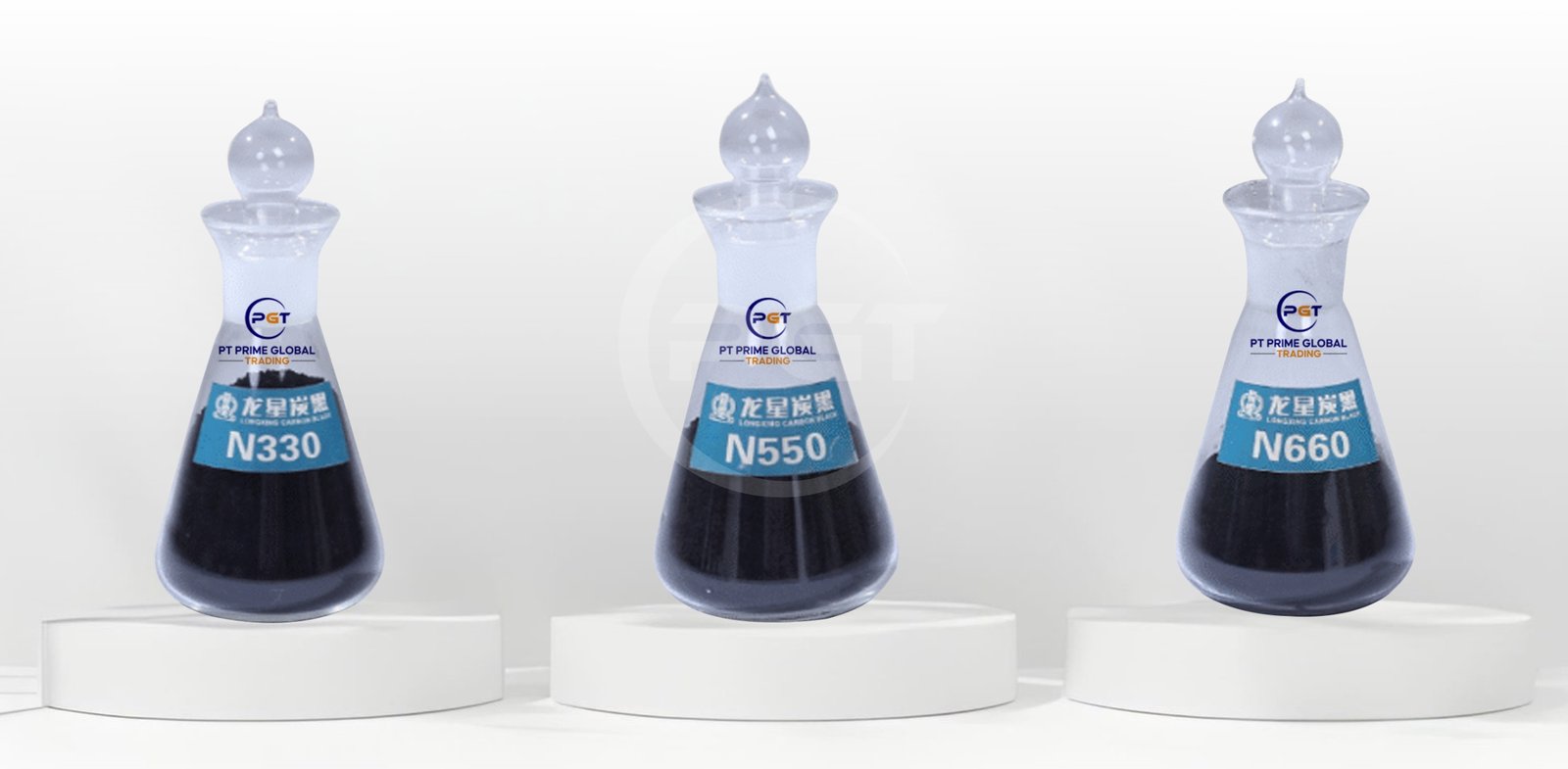
The Dark Matter of Manufacturing: Demystifying Carbon Black Grades N330, N550, and N660
Pure natural rubber is actually a milky white substance. It is relatively soft, structurally sensitive to extreme temperature changes, and wears down quickly under friction.
So, how does it transform into a tough, heavy-duty black rubber compound that can endure thousands of miles of highway friction or seal heavy industrial machinery?
The answer lies in a vital elemental engineering component: Carbon Black.
Produced by the controlled, incomplete combustion of heavy petroleum products, carbon black acts as a primary reinforcing filler. At a microscopic level, it physically bonds with rubber polymer chains to dramatically increase tensile strength, tear resistance, and wear longevity.
However, carbon black is far from a one-size-fits-all material. The industry relies on the international ASTM classification system—most notably the N330, N550, and N660 series—to match specific particle sizes with distinct manufacturing goals. Let’s break down how these three grades differ and where they are deployed.
Understanding the Particle Size vs. Performance Trade-off
When evaluating ASTM carbon black grades, two primary physical properties dictate behavior: lodine Adsorption (Surface Area) and DBP Absorption (Structure).
- Smaller Particle Sizes: Offer higher surface area, meaning more contact points with the rubber matrix. This maximizes wear resistance and tensile toughness but increases heat buildup during movement.
- Larger Particle Sizes: Provide excellent processability, smoother extrusion dynamics, and lower heat generation, making them ideal for inner components.
The Big Three: N330 vs. N550 vs. N660
1. Carbon Black N330 — The High-Wear Specialist
- Classification: HAF (High Abrasion Furnace)
- Characteristics: N330 features relatively small particles that deliver superior abrasion resistance, high tensile strength, and excellent tear properties.
- Primary Applications: This is the quintessential tire tread grade. It is the raw material chosen for components that face direct contact with punishing terrain, such as automotive tire treads, heavy-duty conveyor belts, and high-load industrial rubber soles.
2. Carbon Black N550 — The Structural All-Rounder
- Classification: FEF (Fast Extruding Furnace)
- Characteristics: N550 offers a balanced middle ground. It provides a highly structured particle profile that allows raw rubber compounds to be extruded smoothly through factory dies without deforming, while still contributing moderate reinforcement.
- Primary Applications: Widely relied upon for tire carcass structures, sidewalls, inner tubes, automotive hoses, and complex geometric rubber profiles where dimensional stability during curing is paramount.
3. Carbon Black N660 — The Low-Heat Performer
- Classification: GPF (General Purpose Furnace)
- Characteristics: N660 features the largest particle size among these three options. Because of its lower surface area interaction, it generates minimal heat under repeated flexing (low hysteresis) and allows for incredibly high filler loading, keeping manufacturing costs down.
- Primary Applications: Extensively used in tire inner liners (where air retention matters more than road friction), cable jacketing, rubber molded gaskets, and dampening seals that experience constant physical vibration.
Summary Matrix: Finding Your Grade Match
| Grade | ASTM Designation | Main Physical Benefit | Core Factory Use Case |
| N330 | HAF | Maximum abrasion & tear resistance | Tire treads, heavy conveyor belt faces |
| N550 | FEF | Smooth extrusion & structural shape retention | Tire sidewalls, complex industrial hoses |
| N660 | GPF | Low heat buildup & cost-effective blending | Tire inner liners, gaskets, cable shields |
Sourcing Security for the Indonesian Rubber & Tire Sector
Indonesia stands as one of the world’s largest natural rubber producers, housing critical automotive assembly lines and tire factories that supply the entire Asia-Pacific region. For procurement officers managing these massive production floors, securing a steady stream of imported high-quality carbon black is essential to keeping the mixing lines moving.
Because carbon black is highly powdery and intensely pigmented, transport and packaging integrity are vital. Moisture exposure or bag ruptures can compromise factory safety and ruin entire blending batches.
Secure Your Material Pipeline with PT Prime Global Trading
At PT Prime Global Trading, we specialize in managing the rigorous end-to-end import logistics necessary to deliver premium Carbon Black (N330, N550, and N660) directly to industrial hubs across Indonesia.
We ensure that all chemical consignments are accompanied by rigorous Certificate of Analysis (COA) data, handled in dry, weather-tight multi-ply packaging, and vetted by top pre-shipment inspectors (such as SGS or Sucofindo) to guarantee consistent particle structures every single time.
Ready to Request an Allocation or Commercial Quote?
Let us optimize your raw material supply chains. Contact our industrial sales desk today to submit your specific mesh requirements, arrange sample evaluations, or lock in competitive contract pricing.